
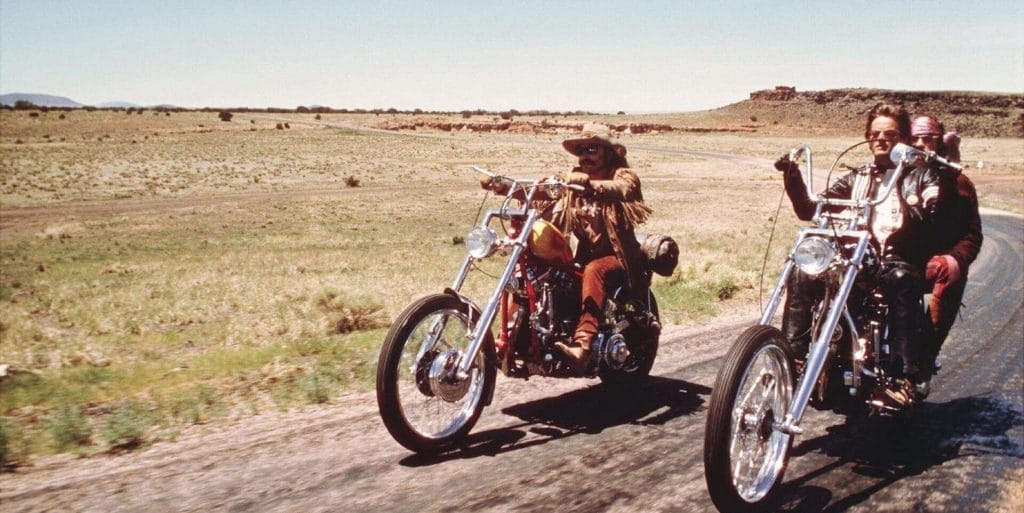
Easy Rider shows how subtext is not what most teachers and gurus tell you it is. Many mistake subtext with non-verbal communication. It is true that most of our communication is non-verbal, but when you can write this well, it doesn’t mean you master subtext. I believe we need to re-think the oversimplified secrets-and-lies approach to subtext.
Robert McKee went in the right direction with his statement “If the scene is about what the scene is about…” But great writing does not stop at avoiding to ‘write on the nose’.
We just need to go a little further.
I saw Easy Rider for the first time a long time ago. In fairness, I was never too keen on seeing it again. My recollection of it was slow, self-indulgent, and celebrating a culture I am not a part of.
Recently I studied thresholds, those sequences in movies where characters are on the move, as a metaphor of their psychological progress. I wanted to understand what this legendary road movie had to say about that.
Arthouse With A Story
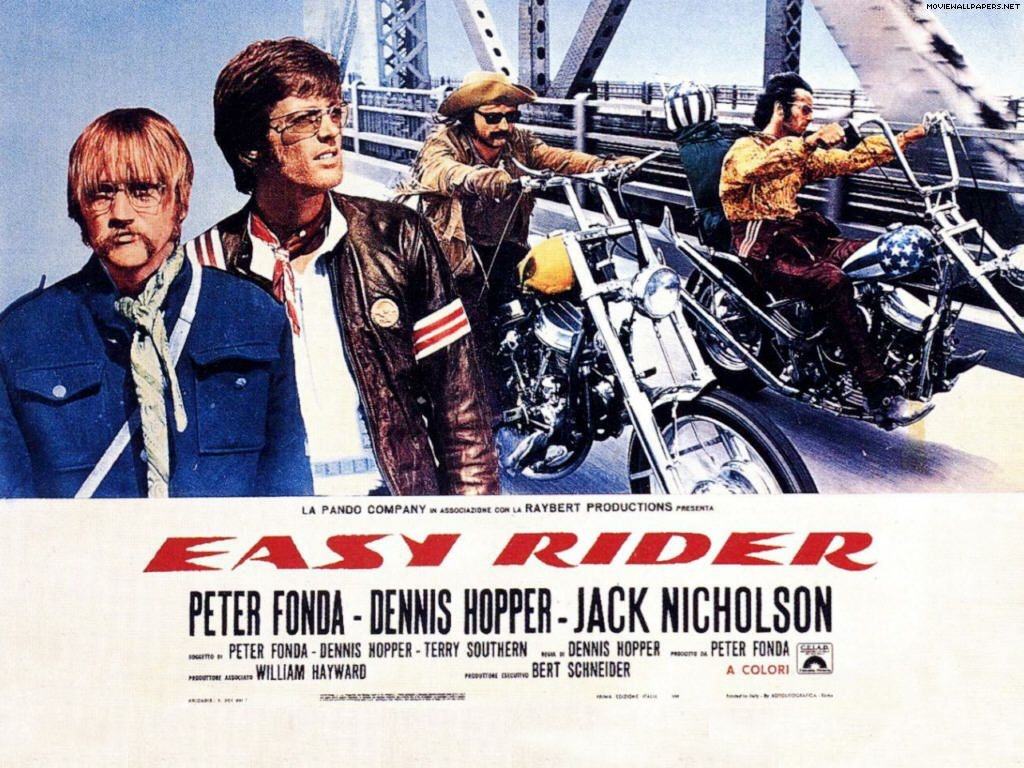 Easy Rider was released in the year Nixon took office. Close to fifty years later, it is baffling how little has changed in the grand scheme of the American socio-political landscape. Easy Rider feels like an end-of-an-era movie, and today we are there again. While all hope is lost, the masses are watching Captain America and preparing to vote for Trump.
The first seven minutes of Easy Rider show what anti-heroes Billy and Wyatt (Captain America) are all about: two seemingly careless bikers who finance their freedom with the occasional drug deal.
When the opening credits roll over Steppenwolf’s Born To Be Wild, the film is already breaking new ground, as soundtracks had never consisted of existing song compilations. Against some spectacular cinematic backdrops – trademark of the movie and its cinematographer Laszlo Kovacs – the sequence launches the first minor threshold, leading us into the story.
And this may be an arthouse pic, but there is a clear visible goal: to make it to New Orleans in time for Mardi Gras.
Of course this is not the type of film that keeps you hooked because of its riveting plot. What matters lies under the surface.
No Subtext Without Serious Digging
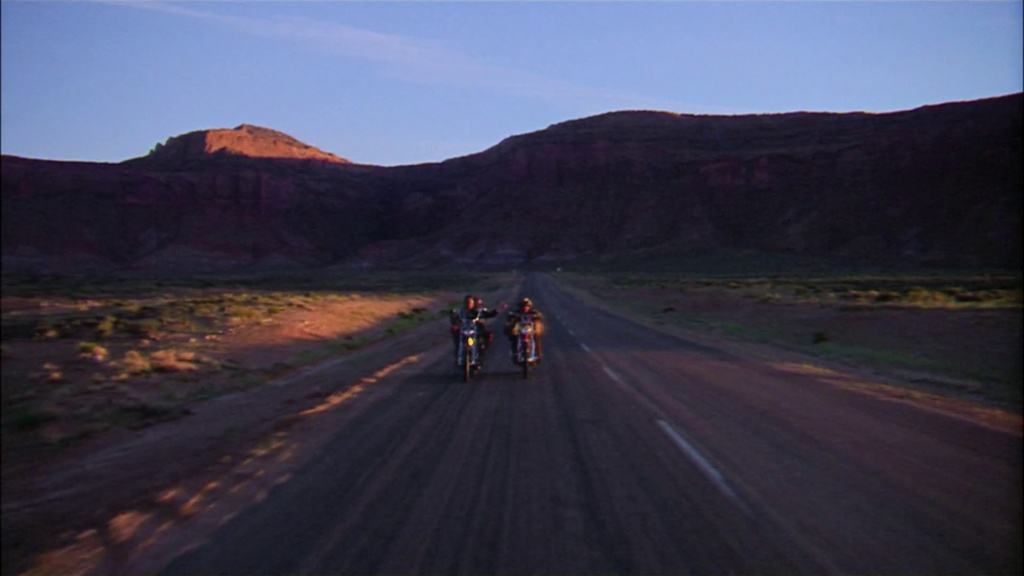 After the hippies pick up a hitchhiker, and fill up with gas, we’re in for some serious musical sightseeing. Over The Weight by The Band, the bikers cruise through Monument Valley, where they hole up for the night.
After the beauty, fun and freedom of the riding scenes, Wyatt now seems reflective; perhaps even tormented.
Billy asks “What’s the matter?” Wyatt replies: “I’m a little tired.” Later he says “I’m just getting my thing together.” I believe that’s exactly what this movie is about.
In the non-verbal, conventional sense , what Wyatt is saying here is “I don’t really want to talk with you any further right now.” The real subtext of the scene will only transpire later in the movie, when a pattern is established.
That pattern: Wyatt is tired of this life. He is ready to make new choices. Always being on the run from society may not be the solution for him. To me this seals the first act of this film; we know the destination, and we understand the psychological challenge the hero is facing.
America Getting Its Thing Together
Easy Rider is Captain America’s quest for identity and purpose, and by association, this is a metaphor for the nation’s journey towards redemption. Metaphors are part of the deeper subtext of a story.
When Billy laughs irreverently, the hiker tells him to be ‘a trifle polite’, as “the people this place belongs to are buried right under you.” In a non-verbal sense, the hitchhiker doesn’t like Billy’s attitude.
On a broader subtextual level, this may be why the hiker has fled the city. Because it builds on the burial grounds. His remark to Billy may also be criticising the nihilist attitude of those who attack everyone and everything, but don’t have a valuable alternative to offer.
Billy has long lost any values he might have had. He now floats from one high to the next, ignorant and numb. Without Wyatt, he is nobody. Wyatt seems to be more aware. He wasn’t born to follow – tons of subtext in the music, here – and he is still hopeful for that redemption. If only he might find himself somewhere along Route 66.
Spoiler alert: he won’t.
What Subtext Really Is About
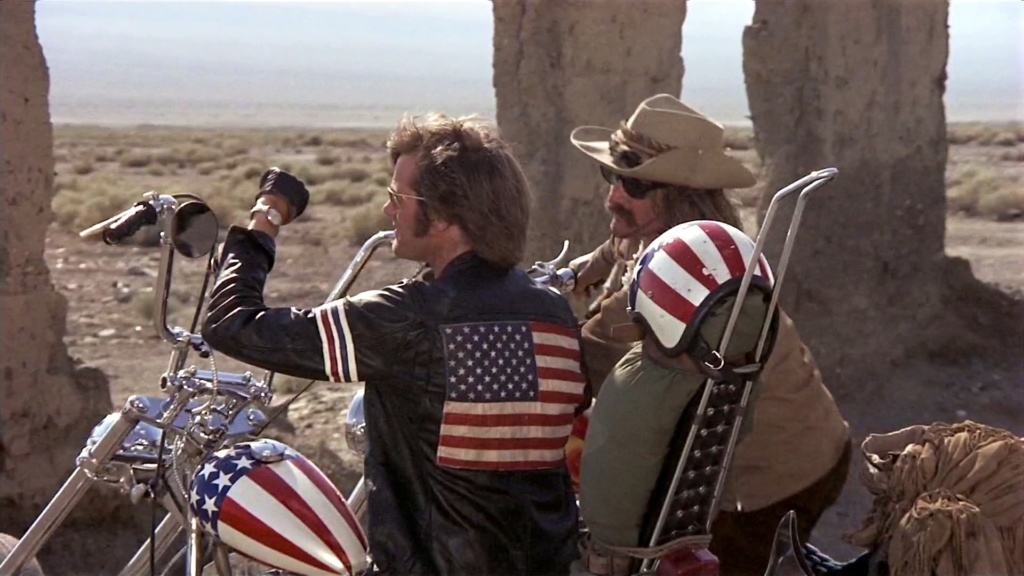 Father Henry Fonda didn’t understand what his son Peter was going on about with Easy Rider. This is not your regular Hollywood picture. Its meaning doesn’t lay bare on the surface. But it’s there for those willing to look.
A scene early in the movie sets it up. Billy (Hopper) and Captain America (Peter Fonda) invite themselves for lunch with a farmer and his large family. “My wife is catholic, you know.” Wyatt commends the rancher on the fact that he’s built a good living for himself.
The contrast between the rancher and his family, and the free-riding bikers who haven’t achieved anything tangible is stark. For Wyatt, this is a call to adventure. Perhaps it is a solution to his empty soul.
“No, I mean it, you’ve got a nice place. It’s not every man that can live off the land, you know. You do your own thing in your own time. You should be proud.”
And although Captain America is literally saying what he means, this line of dialogue provides true subtext. It is the meaning of the movie, and we are not (yet) aware of it. It will gain greater depth as the movie rolls on, and if we make an effort to look beyond merely non-verbal communication, we will slowly become aware of it.
Wyatt is ready to seek a purpose. He even considers settling. Easy Rider is the journey he goes on to figure this out.
-Karel Segers
https://ozzywood.wistia.com/medias/eo7ckdll5v?embedType=iframe&seo=false&videoFoam=true&videoWidth=1080