
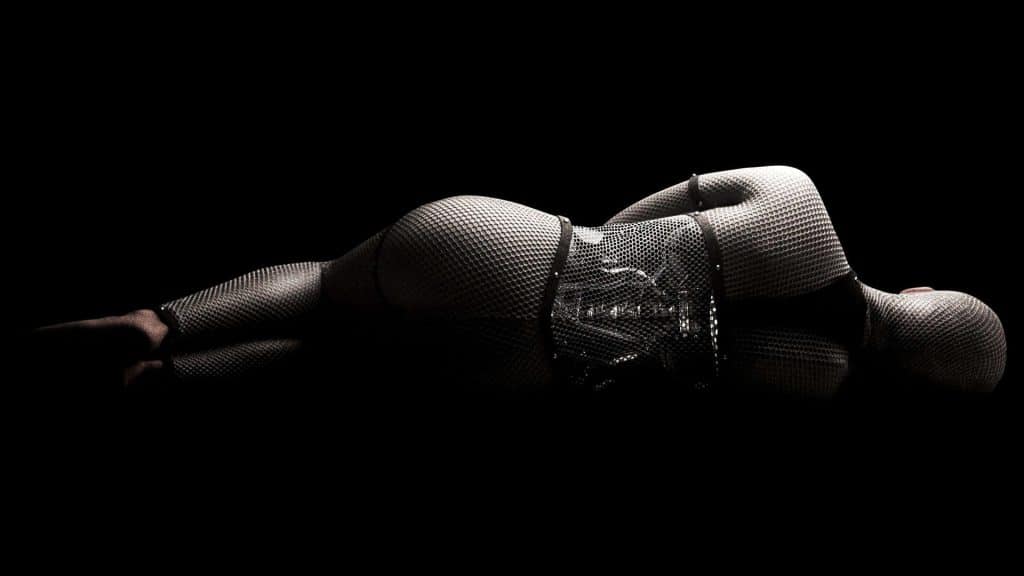
Alex Garland has mastered storytelling for a long time. I remember the novel The Beach to be a riveting read. Here I will show you how he lifted his own screenplay for Ex Machina from gold to platinum level, through inspired direction. This will only take one scene.
At the time of the screen adaptation of Alex Garland’s The Beach, all eyes were on the director, Danny Boyle. But the original author went on to write an original script for 28 Days Later, Boyle’s next movie. It returned its budget tenfold.
Next, he wrote the adaptation of Ishiguro’s novel Never Let Me Go; and with Ex Machina Garland made an impressive transition to directing. It seems he is hooked on directing now. With Annihilation (2017), he isn’t even working from his own original material any longer.
Spoilers Needed [and you’re warned]
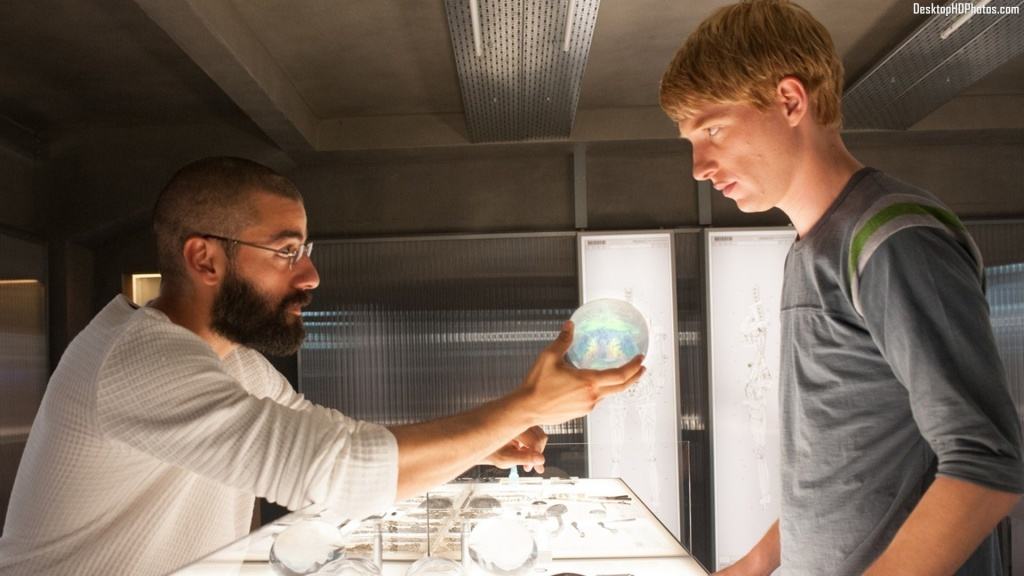 Ex Machina is not a crowd pleaser; rather a challenging piece of genre cinema, made on a relatively low budget of $15m.
Computer programmer prodigy Caleb wins an invitation to the remote mountain estate of company owner Nathan, to conduct a secretive experiment. He is to perform a Turing test on a female AI robot, Ava.
The movie’s ending is not a happy one for our unassuming programmer, and it didn’t appeal to the mainstream audience, either.
Interestingly, I found the movie’s outcome a lot more palatable at a second viewing, when I was prepared for it.
And for you to be prepared, you really need to understand the mid point reversal in this film.
Deus Ex Machina
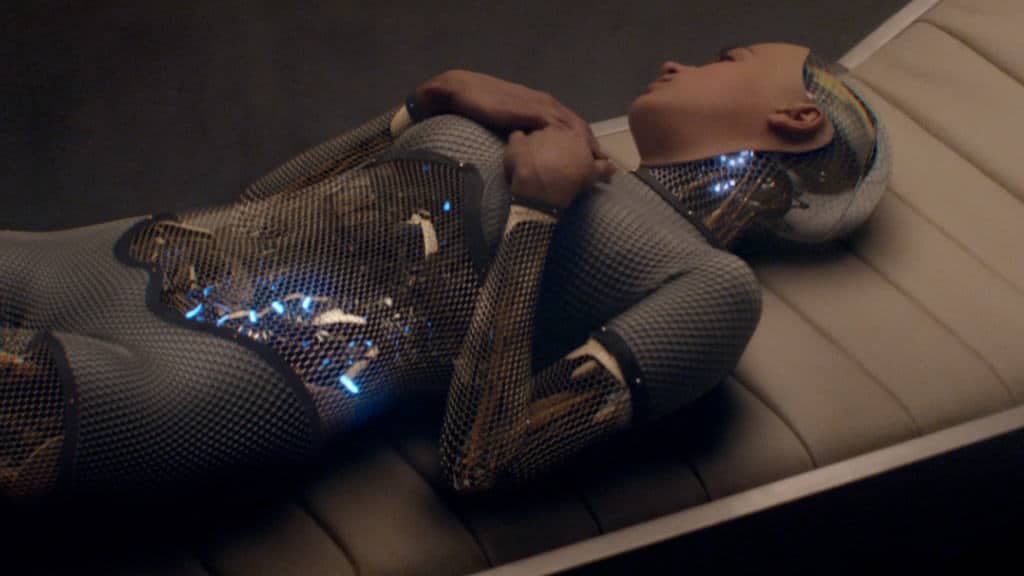 Deus ex machina is a term for the lazy story device that fixes issues by using unexpected, unlikely turns. The phrase originated in Greek theatre, where often characters were introduced on stage by means of a mechanical contraption – a machine. Ava in Ex Machina is a manmade machine; put on stage by her (anything but god-like) creator Nathan.
It’s Caleb’s job to determine whether Ava is really a machine, or indeed a conscious being. That’s the basic plot.
Like the chapters of a book, this story is largely subdivided into sections that each start with Caleb’s meeting with Ava.
With each “Ava Session”, he is more intrigued, to the point that he completely falls for Ava’s beauty, intelligence and purity.
So there’s a love story, too. But what is the movie about on a deeper level?
The key to the answer lies in one scene, and one scene only.
Ava Session #4
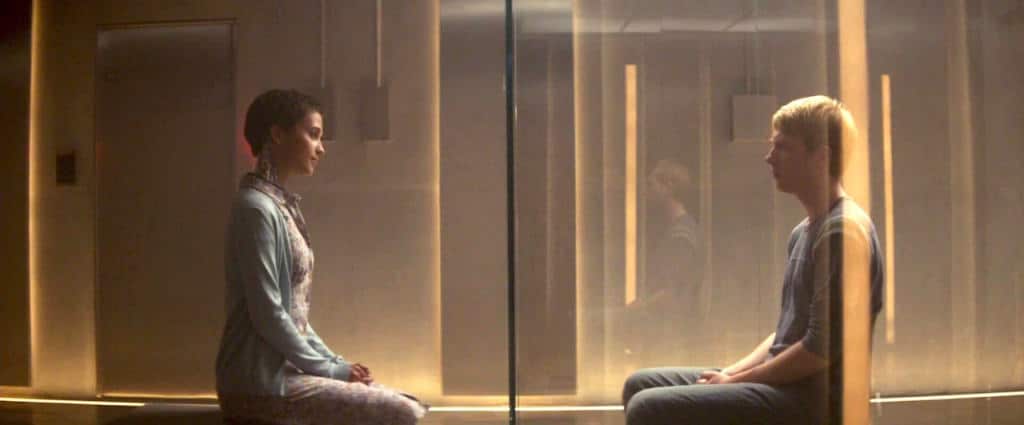 The movie’s most powerful moment sits at the halfway point – and you may not even have noticed. It’s a deceptive moment that revealed its secrets to me only upon re-watching.
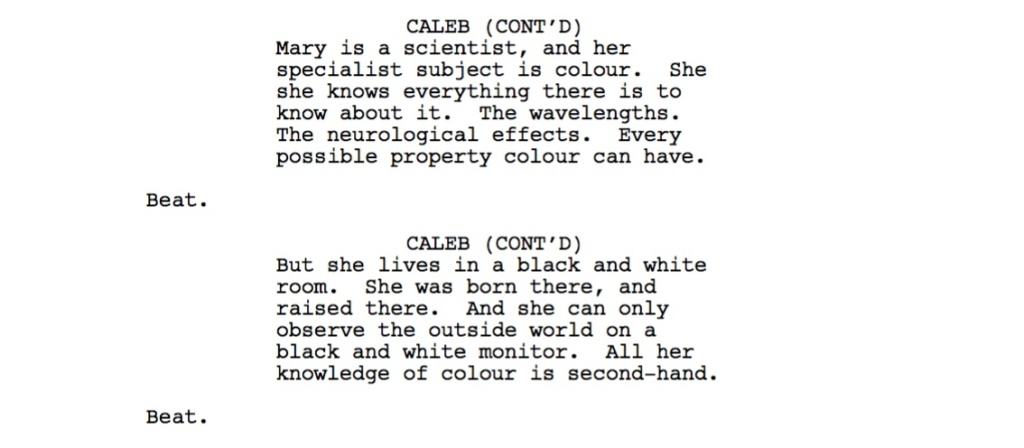
Caleb tells Ava about a thought experiment called “Mary-in-the-black-and-white-room.” Ava gets that the story is really about her. She doesn’t like what she hears, and she shows it through a subtle facial reaction.
Much of this is unique to the finished film, and not evident in the screenplay. The script has just dialogue, no big print subtext.
What we see on the screen tells a far richer story…
Garland’s Hidden Clues
 First off, the framing of the scene gives some clues. It opens with what almost looks like a split screen, a line running vertically straight through the middle; Ava on the left, Caleb on the right.
If you believed that a connection has been growing between these two characters; this strong visual separation tells us a different story.
The exact positioning of the characters left and right may not seem relevant to the occasional screenwriter, but it is to the skilled director. If you were to carefully review Caleb’s earlier sessions, you would notice that Caleb was positioned on the left, the natural place on the screen for any protagonist.
What Garland says by placing Ava on the left hand side in this scene, is this: Caleb has lost his spot as the main character. Ava now leads. The second half of the film confirms this, and the ending simply doesn’t work without this realisation.
A moment later, we see exactly what Ava thinks and feels through flashes of black and white, then colour imagery. These intercuts can really only be Ava’s imagination; her internal response to the story. In other words, we have now also entered her POV.
More proof that her character is fit to take the lead in this movie.
Finally, it is also revealed to us that Ava triggers the power cuts. She is – and has been – propelling the story.
Complete Story Reversal
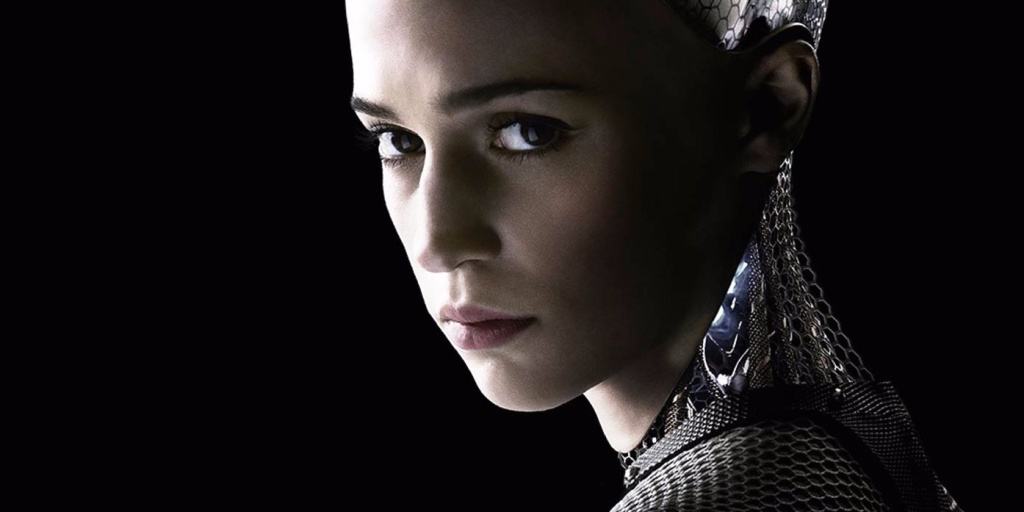 Here is a character who is fully in control. Not only does the AI robot have intention, she is controlling where the story goes, including all other characters. If you don’t go with the director, and leave Caleb’s POV, you are in for a profoundly dissatisfying experience.
Many great movies have mid points that essentially signify a reversal of some kind. But here the reversal is complete. We shift to an entirely different main character altogether.
What all this means for the theme, and the statement the film makes, I leave for you to decide. But perhaps this really good analysis may be of help (IF YOU CAN HANDLE THE ALL CAPS). And if this isn’t enough, check out this podcast with Alex Garland interviewed by Jeff Goldsmith.
Enjoy the scene, and please leave your comments below!
-Karel Segers
https://ozzywood.wistia.com/medias/mze2voyecu?embedType=iframe&seo=false&videoFoam=true&videoWidth=1080
(Download the script excerpt here)