
The flashback – like its ugly brother the Voiceover – has caused some heated debate. If used well, it can be a great way of getting exposition across or spicing up your script. If used badly, flashbacks suck. Worst case scenario, they can seriously dullify your story.
by Karel Segers
I’m not going to talk about all-out non-linear movies such as Pulp Fiction or Memento but look instead at films that have a clear story in the present, from which we – repeatedly – jump back in time.
Happy In The Past
Did you see Ladder 49 (2004) and wonder what went wrong in that movie?
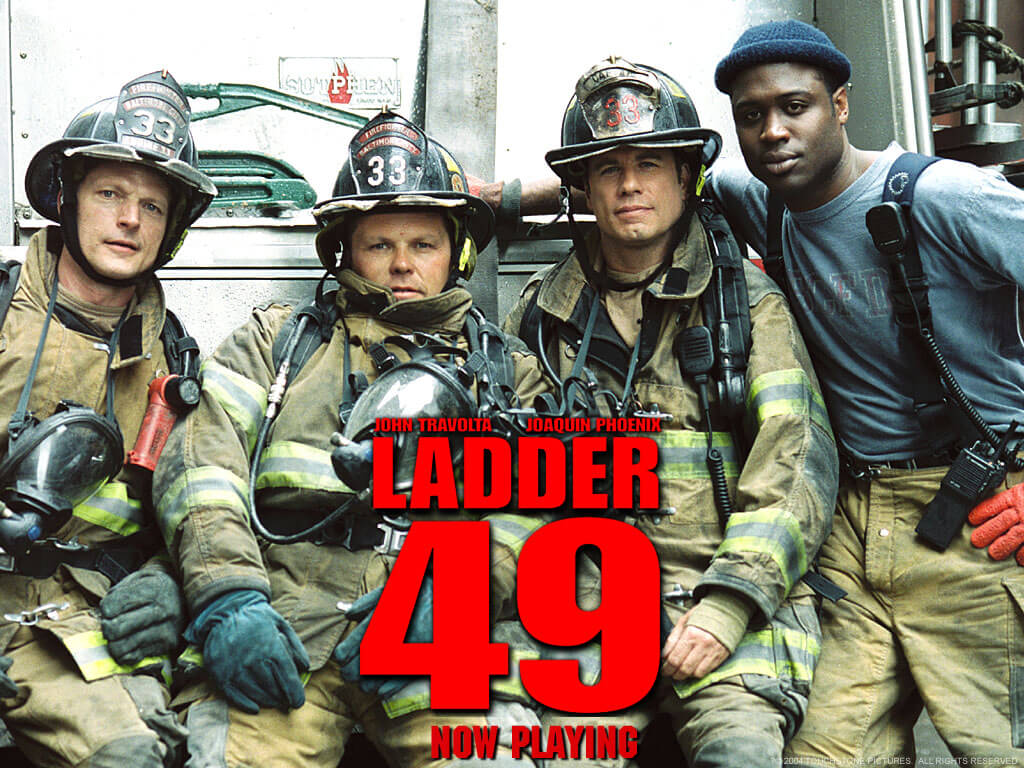
The drama in the present is about Joaquin Phoenix’ character, a firefighter trapped inside a blazing multi-story factory. While he’s lying there helplessly, he reminisces about his past life and this plays out as a series of flashbacks. This reviewer points at the main issue:
For a full 45 minutes, flashback is used completely without drama, and the movie drags itself along at a snail’s pace. In fact we don’t care about those flashbacks much, as we just want to know what’s going to happen in the present, when our hero’s life is in danger. The problem is that this present story takes up no more than a third of the movie’s total screen time.
we don’t care about those flashbacks much,
as we just want to know
what’s going to happen in the present.
Admitted, Ladder 49 did half-okay with its worldwide, all-time gross of $100m but for a movie with Travolta and Phoenix and an undisclosed budget, this is probably the mark of a flop. Reviewers at the time suspected that the pic relied on emotions in the aftermath of 9/11 and the admiration for the Ground Zero firefighters. This theory is substantiated by the fact that the movie only made a measly 25% of its worldwide gross outside the US.
Back to our story analysis.
Flashbacks No Fix
I believe this: if a dramatic situation is set up in the present story, any time spent on a non-dramatic flashback is wasted. The audience wants to see the drama unfold, intensify and resolve in the present. And if a present-day situation is not dramatic, a series of dramatic flashbacks won’t fix it. Ultimately audiences are drawn to what is happening in the present-day story.
any time spent on non-dramatic flashbacks is wasted.
Did you see Kathryn Bigelow’s The Weight Of Water (2000)? Probably not. It did a measly $110,000. From what I remember, a recurring dramatic flashback informs a largely undramatic present day mystery. The result bored me senseless.
Here’s what Roger Ebert had to say about its structure, which cuts back and forth between a present and past storyline:
Recently I read two screenplays that had similar problems with their use of story time. In both scripts the flashbacks ate up more screen time than the present story. Consider this a big fat red flag. Secondly, the flashbacks were more dramatic than most of the present story.
Show – Don’t Illustrate
 One of the scripts was a short film in which two people in a bar tell each other dramatic stories and these stories are shown in flashback. In my view this ‘illustrated telling’ doesn’t qualify for ‘show don’t tell’. Ultimately the audience knows that in the present the two people are safe, in the bar – and this situation is completely un-dramatic.
Most films that use flashbacks well, do it to intensify the drama in the present story, not to compensate for it.
The other screenplay – a feature – had a gripping story in the present but for about half of the screenplay, this story is not progressed. The issue is vaguely similar to the one in Ladder 49. Here, the writer set up a lengthy expositional backstory of a supporting character in order to enhance a single dramatic moment in the third act.
Most films that use flashbacks well,
do it to intensify the drama in the present story,
not to compensate for it.
If you are going to use flashbacks, use them sparingly. Avoid to make them more dramatic than your story in the present.
Oh, and finally: don’t show flashbacks from other point of view than your main character.
Unless, of course, you are an auteur.